From Dalby to the Land Court Indigenous graduate finds his place in law
Yalari Alumnus Connor McGovern-Cubby (Class of 2021, Anglican Church Grammar School) has recently completed a Bachelor of Laws at Bond University, a milestone that reflects his determination and commitment to making the most of every opportunity. Throughout his studies, he was supported by the generosity of FTI Consulting through the Pathways Scholarship Program, which supports Yalari graduates as they transition into university, vocational training or early employment.
The following story was originally published by Bond University.
If they handed out grades for gratitude, Connor McGovern-Cubby would have two High Distinctions. The first Indigenous graduate in his family, Mr McGovern-Cubby is leaving Bond University with a law degree, a full-time job and an associateship in the Land Court waiting for him next year.
But ask him how he got here and he’s quick to shift the focus away from himself. Yes, he grew up with circumstances that could have made his path into higher education difficult.
His three younger siblings spent years in foster and residential care, moving through more than 100 different homes and eventually becoming involved with the youth justice and justice systems.
Seeing first-hand how the legal system could shape the lives of First Nations families was one of the reasons Mr McGovern-Cubby decided to study law. But it is not how he wants his story defined.
“I don’t want my story to come off as, you know, I’m from a deficit point of view,” he says. “These are very real issues within my community, but it’s not my entire story. Yes, I do come from somewhat of a disadvantaged background, but against all those odds, I’ve had a lot of support.”
That support has come from many places: his family, mentors, scholarships, the Yalari Foundation, Bond’s Nyombil Centre and, eventually, a growing network of people within the legal profession who helped him believe he belonged there.
Mr McGovern-Cubby grew up in Dalby on Queensland’s Darling Downs, the son of a Kamilaroi mother from Mungindi in northern NSW and a non-Indigenous father from Dalby. His parents separated before he was born, but his father and paternal grandparents made sure he remained connected to his mother’s family.
He was fortunate to receive a Rosemary Bishop Indigenous Education Scholarship through Yalari, which enabled him to attend Anglican Church Grammar School in Brisbane (Churchie).
It was there that the possibility of university first opened up.
Yalari’s support has remained important to Mr McGovern-Cubby well beyond his school years. He has returned to Churchie to speak with Indigenous students, sharing his own journey from Dalby to boarding school and eventually Bond.
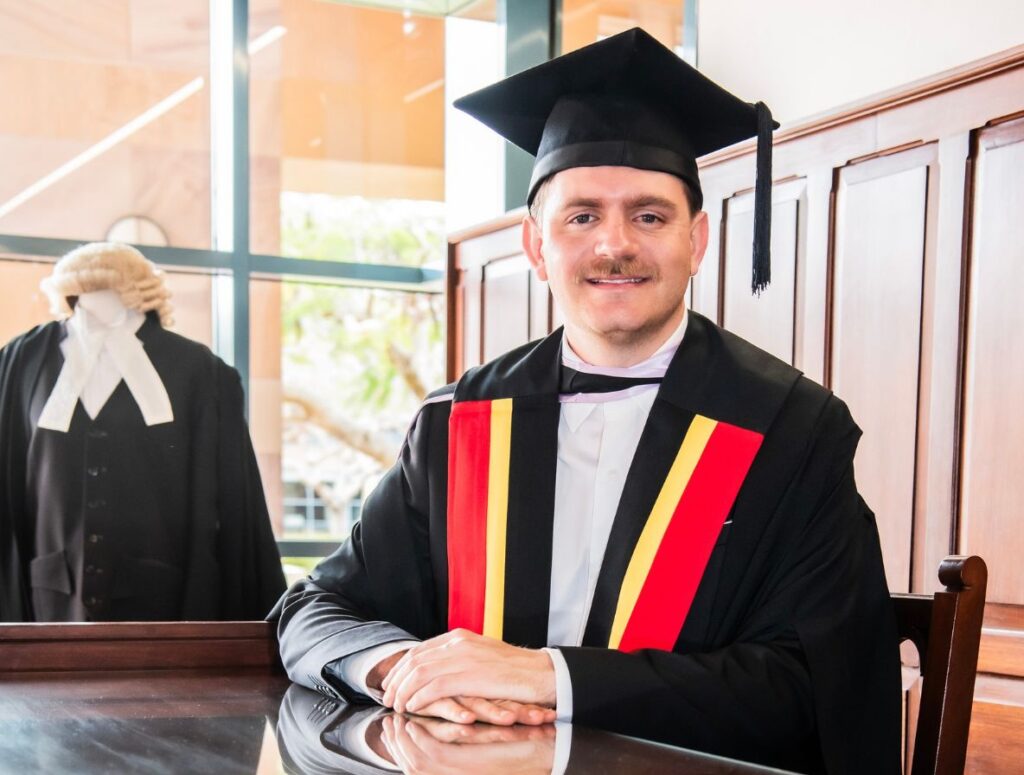
Connor McGovern-Cubby recently graduated from Law School at Bond University (photo credit: Cavan Flynn)
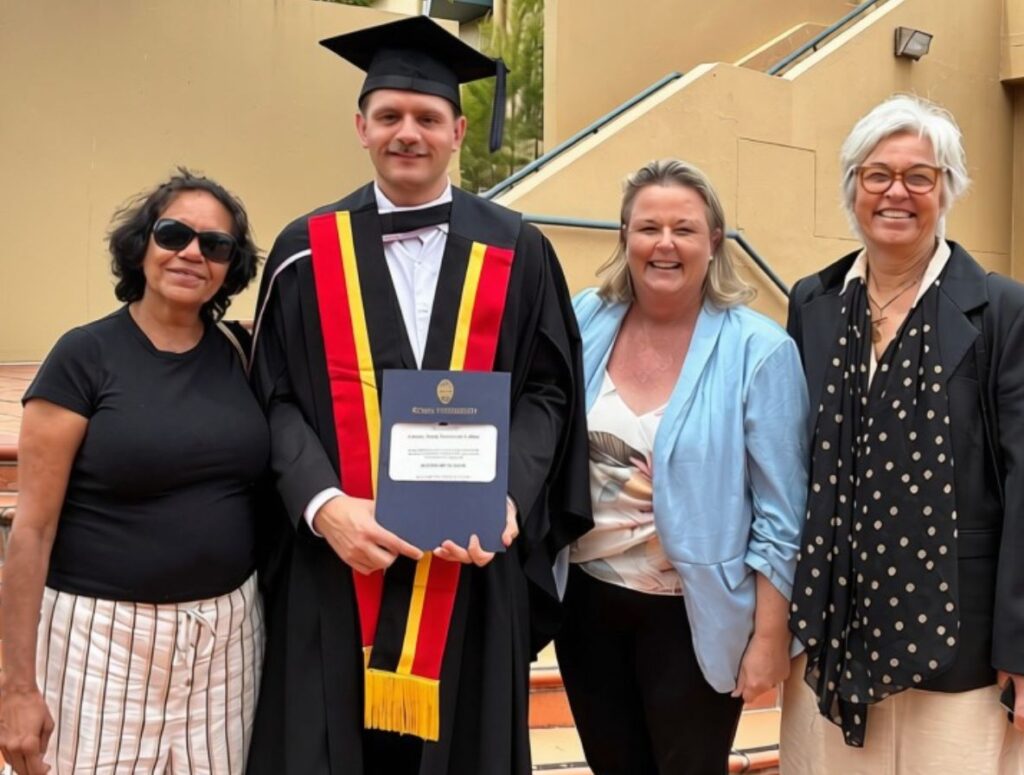
Connor celebrates the occasion alongside his mum (left), Yalari Alumni Transitional Support Lead, Lesa Hippisley (right), and Yalari Partnerships and Bequests Manager, Lou Wilson (far right).
On graduation day, three members of the Yalari team will be there to celebrate with him.
“It’ll be very special,” he says.
At Bond, an Indigenous scholarship through the Nyombil Centre provided another important source of support as Mr McGovern-Cubby embarked on a Bachelor of Laws. He arrived without family members in the legal profession and with little idea of where a law degree might take him. Initially, he was not even sure becoming a lawyer was for him.
And there was another problem. To pay for his accommodation, Mr McGovern-Cubby was working more than 40 hours a week in hospitality and the workload took its toll.
“I wasn’t getting great grades and I didn’t feel confident to put myself out there,” he says.
For a while, he was simply trying to keep everything moving. Then he decided to take a chance.
He applied for the Bar Association’s Indigenous Law Students Program, which gave him the opportunity to spend a week in a barrister’s chambers, a week with a Federal Court judge and a week in the Queensland Supreme Court.
He spent time with Justice Berna Collier, Chief Justice Helen Bowskill and District Court Judge Suzanne Sheridan, and watched a full criminal trial. The experience changed something. While at Higgins Chambers in Brisbane, the head secretary encouraged him to apply for a research clerk position. He did and was accepted. The confidence that followed began to change his academic results too.
“I pretty much went from a passing student to now Distinctions, and I got one HD,” he says.
The reason, he believes, was not simply that he had reduced his hospitality hours and eventually left the job. He had found a community of legal professionals who believed in him and encouraged him to succeed.
“I didn’t know anyone in the law,” he says. “There’s a perception that it is a little bit of an inside club, but the reality is that’s not the case. There are amazing people who work in the law and are willing to help anyone, no matter what background they are from.”
That realisation has shaped the way Mr McGovern-Cubby now approaches his own opportunities. A clerkship at criminal defence firm Gilshenan & Luton has led to a full-time role as a paralegal. Next year, he will undertake an associateship in the Land Court. He is still exploring where law might take him.
“Someone said to me, you do have to try everything,” he says. “Give something a crack, whether you might find it interesting or not.”
Perhaps nothing captures that philosophy better than the Aboriginal and Torres Strait Islander Moot competition. Mr McGovern-Cubby was initially hesitant when his Bond mentor Associate Professor Narelle Bedford encouraged him to enter. But with teammate Jetta Gardener Dodd, he reached the final in 2024, finishing runner-up. He is particularly grateful to Dr Bedford, whose encouragement helped him take that first step.
“Narelle isn’t just an amazing coach, she has been the heart of the Aboriginal and Torres Strait Islander moot,” he says. “I formed a really strong connection with her and she has played a very important role in my development.”
Mr McGovern-Cubby has since returned the favour. He has coached the team the past two years, helping Jazmin Grant and Harrison Martens reach the 2025 final, with Jazmin named best oralist. This year, Mollie Tucker, Kiera Eljed and Noah Ellis also reached the final, with Mollie and Kiera securing the awards for best oralist and best written submission.
“I’ll keep barracking for the team each year and hopefully we win one soon.”
For Dr Bedford, Mr McGovern-Cubby’s sustained commitment to the competition speaks to qualities that will underpin his career.
“Connor’s three-year commitment to moot competition reflects qualities of preparation, intellectual curiosity and dedication that will serve him well in legal practice,” she says. “The advocacy, teamwork and leadership skills developed through this sustained involvement position him strongly for professional success.”
Mr McGovern-Cubby says the Nyombil Centre also helped develop those qualities.
“I would love to be able to highlight how good that place is because it deserves that recognition,” he says of Bond University’s Indigenous student support centre.
At graduation, his family will be there to celebrate: his father and stepmother, his older brother and sister, his younger siblings, his partner and his mum.
“It is a very special occasion because I’ve got all pieces of my family there to celebrate,” he says. “I’m the first of my siblings to go to university and the first to graduate.”
Connor McGovern-Cubby arrived at Bond unsure of where a law degree might take him. Now, with a career in law ahead of him, he’s ready to find out.